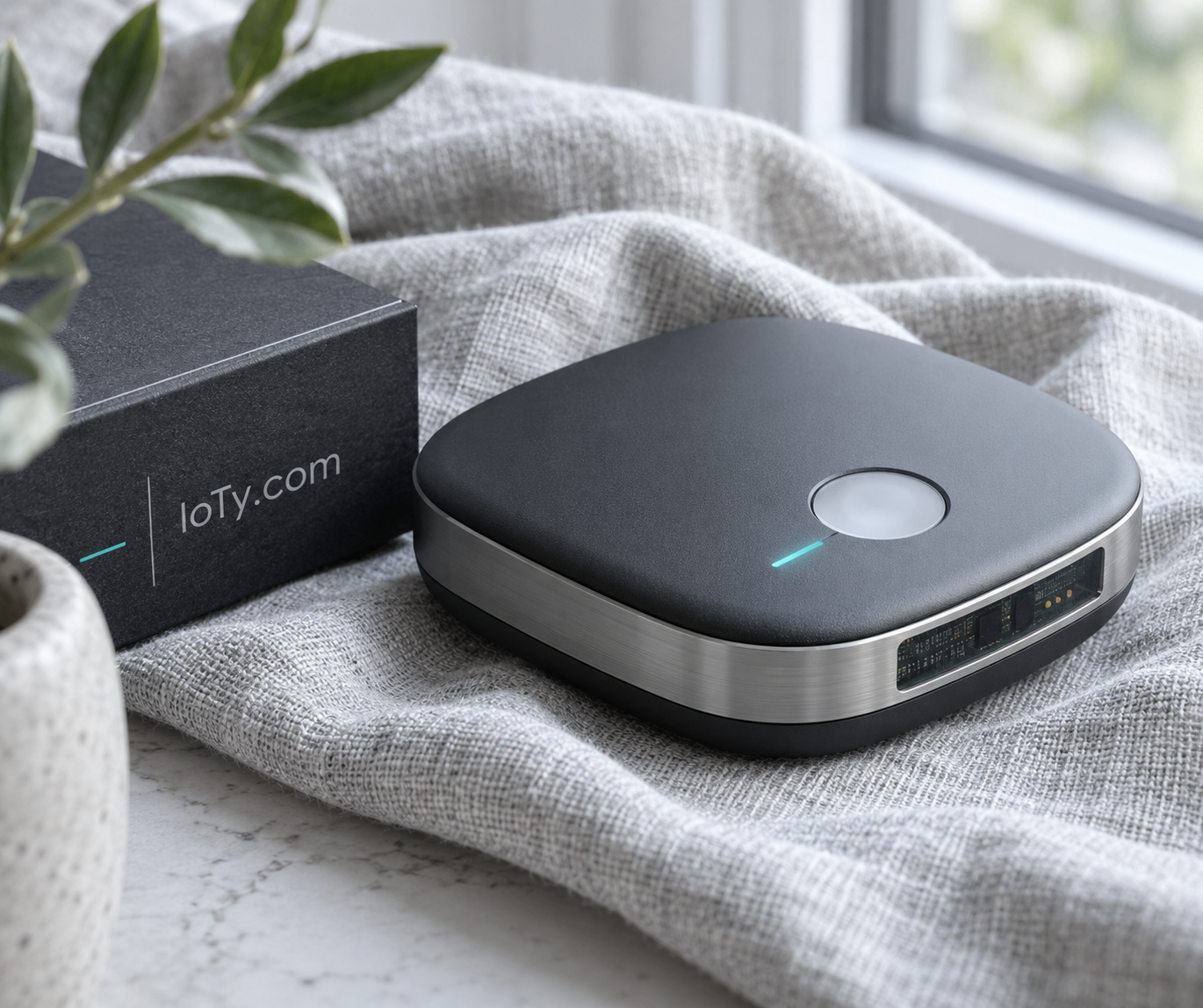
A household device earns its place by doing something useful with little explanation. IoTy.com could give a smart-home product line a compact public identity, while the product names underneath it tell shoppers exactly what each item does. That arrangement leaves the brand broad enough for a second product and keeps the first purchase understandable. The Internet of Things association belongs in the background; the household task belongs at the front.
The following is an illustrative concept for a consumer brand. Start with one buyer and one situation, such as a person who wants to see room conditions without maintaining a collection of unrelated apps. A small room sensor would provide a concrete first SKU to evaluate. Its actual measurements, accuracy, compatibility, and safety requirements would need to be established by the eventual product team.
Make the first box easy to understand
Packaging has limited room. Put the purpose near the product image, explain what comes in the box, and say what the customer needs at home. If a hub, compatible controller, account, or subscription is required, that belongs beside the purchase decision. A short brand mark can leave more space for these practical details instead of forcing the front panel to carry a long company name.
Imagine a package titled “IoTy Room Sensor.” A side panel could describe the setup sequence, supported environments, and where to find the manual. That is a naming illustration, not a proposed performance claim. The buying experience should let someone work out whether the product fits their home before they start comparing decorative features or colors.
Choose a connection story the team can support
Compatibility needs precise language. The Connectivity Standards Alliance Matter FAQ describes Matter as local connectivity and explains that remote control requires an internet-connected controller. It also describes multi-admin support. Those distinctions are helpful when writing a product brief because “works locally” and “works from anywhere” are different customer expectations.
A founder considering this direction should decide which ecosystems to support first, what testing that entails, and how the support team will identify a customer's setup. Avoid making compatibility a catchall badge. Publish a maintained list of supported combinations once they have been verified. Include the version and any conditions that affect the promised experience.
Design the second week, too
The first ten minutes get attention in product videos. The second week reveals whether the household understands the device. Think about the messages shown when a battery needs attention, a network changes, or another family member wants access. Explain the action in ordinary language and give people a way to recover without starting from scratch.
A small product team could test its setup instructions with people who did not help write them. Hand over the sealed package and watch where they stop. Record the question they ask before offering help. Confusion about which button to hold is a design issue; confusion about why an account is needed may be a product policy issue. The remedy should match the cause.
Direct sales and retail ask different questions
A direct store gives the brand room to explain installation, show a complete demonstration, and answer fit questions before purchase. It also makes the team responsible for fulfillment, returns, and support. Retail can put the product near related household purchases, but a shelf label and box must do much of the explaining. Choose the first channel based on the team's ability to serve it.
A practical launch could begin with a small direct audience and a clearly limited product range. Publish the complete setup guide before inviting orders. Record the reasons for returns and the support questions that appear repeatedly. Those observations can improve the packaging before a wider distribution conversation. No sales volume or demand is assumed by this concept.
Give privacy a visible place
Buyers should be able to find what the device collects, where those records go, and how to remove an account. A readable answer should distinguish a room measurement from account information and diagnostic logs. The NIST Privacy Framework offers a broader way to organize privacy risk discussions. A product team still needs its own data map and advice appropriate to its markets.
Plan the end of ownership along with setup. A reset procedure should explain what is removed from the device and what needs a separate account action. A support policy should say how customers learn about updates and where they can find the current support period. These decisions affect packaging, manuals, customer service, and the product itself, so they deserve an owner before launch.
Let a product family grow deliberately
A second SKU should share a buyer need or a useful setup relationship with the first. A room sensor and a compatible display might make a coherent pair. An unrelated gadget could multiply support obligations without making the brand easier to understand. Draw the proposed family on one page and ask what the customer gains from choosing another item under the same name.
IoTy.com would suit a founder who wants that family to have one recognizable address, with room for manuals, support, and a growing catalog. Compare this consumer direction with the device-cloud concept before deciding which business the name should represent. An inquiry can describe the first product, intended market, and acquisition or partnership interest. Domain ownership and any accompanying creative assets would be agreed separately.